
Logo
CO-FUNDED BY THE EUROPEAN UNION

She changed the world.
Nobody wrote it down.

Women crossed borders, fled war and persecution, and kept doing science anyway. Their work shaped Europe. Their names went missing. We're bringing them back — and asking why it still happens today.
eu
UNEARTHING HIDDEN HISTORIES

Two ways to disappear from history

Histories of science mostly tell us about men. Histories of migration mostly tell us about labourers. A woman who was both a migrant and a scientist falls straight through the gap.

Elizabeth Rona moved country after country as antisemitism closed doors behind her, and her radiochemistry was credited to colleagues. Gertrud Kornfeld left Prague when the Nazis rose to power and is still listed as a German chemist. Lise Meitner worked out how nuclear fission happens, then watched someone else collect the Nobel Prize.

These aren't rare exceptions. They're a pattern. And the pattern didn't stop in 1945.
Why this matters now
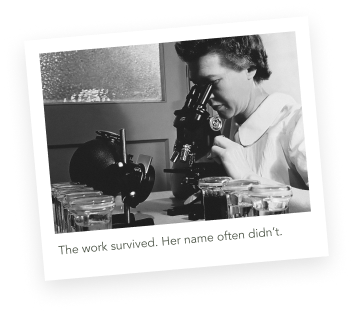
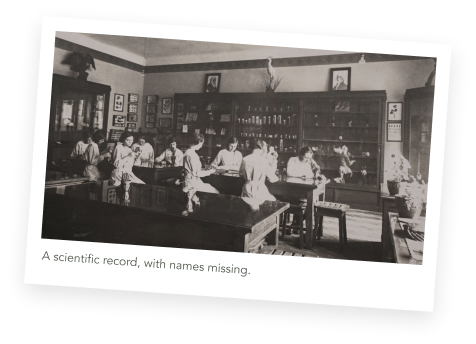
A scientific record, with names missing.The work survived. Her name often didn’t.
WHAT'S HAPPENING

Eight things you can actually join

Four events you come to, two free online courses, an online storytelling lab and a festival. All free, most of it open to anyone from 15 up, and teachers, youth workers and museum staff welcome at all of it.

PRAGUE · MONTH 3 · FREE

The Prague Forum

Historians open the archives, migrant women scientists speak for themselves, and young people run the debates.
01
PRAGUE · MONTH 5

The Archive Lab

Real registers, journals and letters — and how to spot the person who was left out.
02
IRELAND · MONTH 8

From History to Policy

Young people, teachers and policymakers at one table, writing recommendations someone can act on.
03
ONLINE · FREE COURSE

Inspiring Stories

Ninety minutes on your phone, twenty forgotten women, a badge at the end.
04
ONLINE · MONTHS 9–14

The Storytelling Lab

Make a podcast, a film or a mini-exhibition — and get it published.
05
LISBON · MONTH 16

Role Models Across Generations

Schoolgirls meet women who moved country to keep working. Everyone writes a Letter to the Future.
06
ONLINE · FREE COURSE FOR EDUCATORS

Teaching Forgotten Pioneers

Lesson plans, archive exercises and honest advice for the difficult conversations.
07
ATHENS · MONTH 22

Festival of Memory and Science

Pop-up exhibitions, performances and storytelling, made with migrant and refugee women themselves.
08
All eight, in detail

“Leaving people out of the past helped create the inequality we live with now.”

If migrant women are missing from the story of European science, today's migrant women look like exceptions instead of the latest chapter.
TWO YEARS, FOUR STAGES

How it all fits together

MONTHS 1-8
We dig. A forum, an archive lab and a policy seminar recover the stories and connect them to today.
MONTHS 7–14
We share. A free online course goes live and young people start making podcasts, films and exhibitions.
MONTHS 14–20
We teach. Schoolgirls meet scientists in Lisbon, and a course for educators puts it all in the classroom.
MONTHS 20–24
We celebrate. A festival in Athens, and everything we made stays online, free, for anyone to use.
WHO'S BEHIND IT

Five organisations, five countries

A technical university, a youth education agency, a girls' mentoring charity, a migrant-led women's network and a digital learning institute. Each one runs a piece of it.
Czech Technical University in Prague Logo
CZECHIA · LEAD
Runs the Prague Forum and the Archive Lab.
Momentum Logo
IRELAND
Runs the policy seminar and the Storytelling Lab.
Inspiring Girls Logo
PORTUGAL
Runs the Lisbon forum for schoolgirls and mentors.
Melissa Logo
GREECE
Runs the Festival of Memory and Science in Athens.
European E-Learning Institute Logo
DENMARK
Builds both free online courses.
Meet the team

Don't miss the next one

Two years. Eight ways in. Explore events, free courses and a festival across Europe.
Explore events
menu